About Thimphu
Thimphu is unlike any other capital city on earth. It operates without traffic lights — white-gloved traffic police and roundabouts direct the flow — and every building in the city is required by law to incorporate traditional Bhutanese architectural elements: painted wooden facades, sloping eaves, and ornate decorations. Pharmacies, banks, cafés, and government offices all wear the same ancient-looking face. The result is a city that feels simultaneously spiritual and cosmopolitan, ancient and functional.
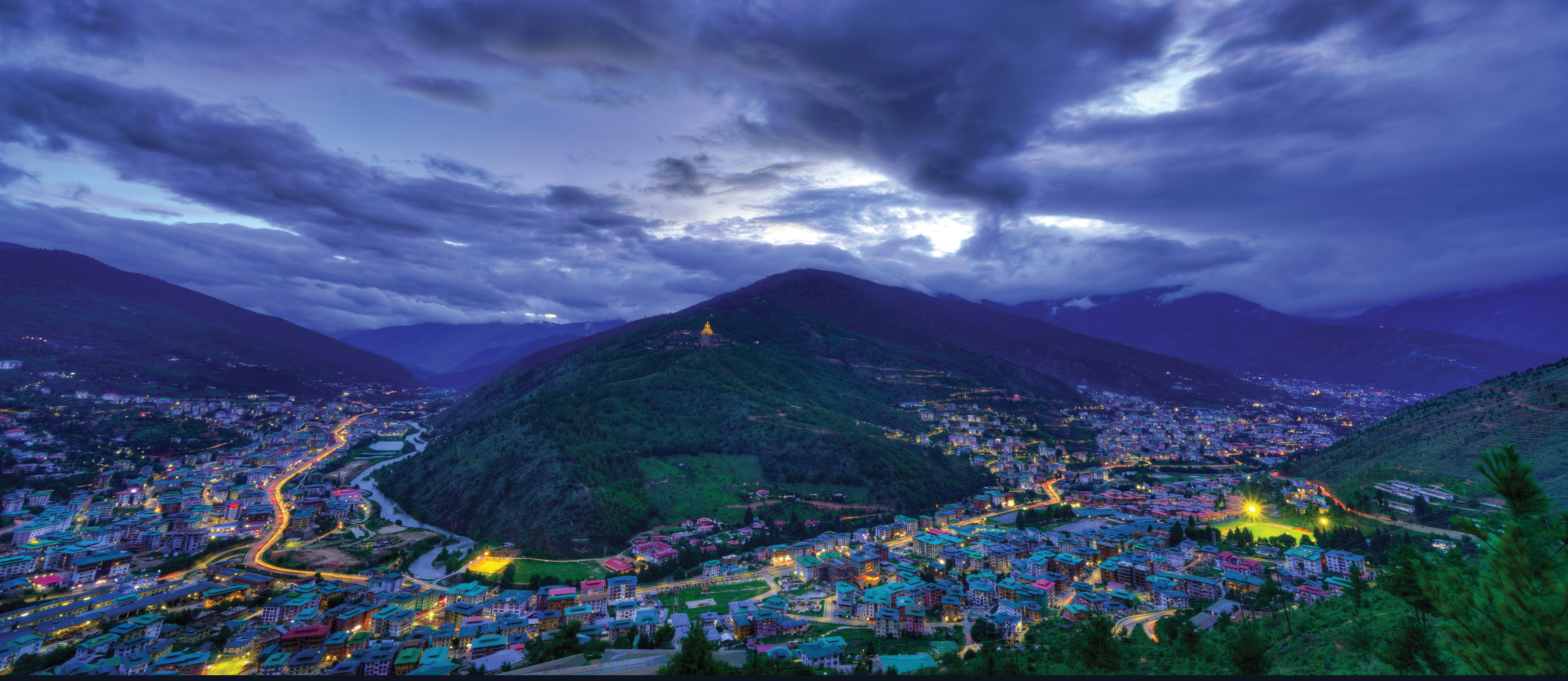
Home to roughly 115,000 people — nearly one-third of Bhutan's entire population — Thimphu sits in the Wang Chhu valley flanked by forested ridges and dominated by the magnificent Tashichho Dzong, the seat of Bhutan's government and the summer residence of the Je Khenpo, Bhutan's Chief Abbot. The dzong's gleaming white walls and golden rooftops are visible from almost everywhere in the city.
Bhutan only connected to television and the internet in 1999, yet Thimphu now has thriving cafés, art galleries, international restaurants, and a craft beer scene — all nested within a city that still pauses each morning for butter lamps, prayer flags, and the elderly faithful circumambulating the Memorial Chorten. For visitors, Thimphu is usually the first stop after Paro Airport, and rewards the curious with world-class museums, extraordinary monuments, Asia's finest traditional arts school, a bustling weekend market, and easy hikes to hilltop monasteries. Plan at least two full days here.
Gallery


Top Attractions
Thimphu packs an extraordinary concentration of culture, religion, and living history into a compact, walkable city. Allow at least two full days to cover the highlights.
Buddha Dordenma — 51.5m Golden Buddha
Sitting on a forested hilltop at Kuensel Phodrang, the 51.5-metre gilded bronze Buddha Dordenma is one of the largest Buddha statues in the world and visible from across the entire valley. Completed in 2015 to mark the 60th anniversary of the fourth king's birth, it fulfils an ancient prophecy and contains 125,000 smaller Buddha images within its bronze interior. The views from the hilltop platform over Thimphu's rooftops and mountains are spectacular — particularly at golden hour. Open daily 9am–5pm; free entry; remove shoes before entering the statue base.
Tashichho Dzong
The gleaming white Tashichho Dzong — "Fortress of the Glorious Religion" — dominates Thimphu's northern riverbank with golden rooftops visible from across the city. Originally built in 1641, completely reconstructed by the third king in the 1960s, it functions simultaneously as Bhutan's seat of government (the King's throne room, major ministries) and the summer residence of the central monastic body. Hundreds of monks chant in corridors that government ministers walk by day. Visitors may enter after 5pm on weekdays and all day Sunday. Witnessing the evening flag-lowering ceremony as the light turns golden is one of Thimphu's great experiences.
National Memorial Chorten
Built in 1974 in memory of Bhutan's third king, this Tibetan-style white stupa with golden spires near the city centre is the most important daily place of worship for Thimphu residents. From dawn to dusk, elderly Bhutanese circumambulate continuously — spinning prayer wheels, murmuring mantras, counting rosary beads. Butter lamps flicker around the base; pigeons spiral above the spires. Spending half an hour here simply watching is one of the most authentic cultural encounters in all of Bhutan. Free entry; donation appreciated.

National Institute of Zorig Chusum
One of the most genuinely fascinating places in all of Bhutan — this school trains students in the 13 traditional arts of Bhutan (Zorig Chusum) through four- to six-year residential programmes. Visitors walk freely through open studios watching students at work: painting sacred thangkas with natural mineral pigments, carving intricate wooden panels, embroidering ceremonial dress, casting bronze deities. Skills unchanged for centuries, taught with quiet dedication. The attached showroom sells student work at fair, honest prices. Open Monday–Saturday, mornings best.

Changangkha Lhakhang
Thimphu's oldest and most beloved neighbourhood temple, established in the 12th century on a commanding ridge with sweeping views of the valley. The main shrine houses a deeply revered stone statue of Chenrezig (Avalokiteshvara) with 1,000 arms. This is where Thimphu parents bring newborns for naming blessings — a monk rolls a dice and the deity guides the choice of name. The resident monks, resident dogs, spinning prayer wheels, and spectacular views make Changangkha a perfect, peaceful contrast to the busier dzong. Often blissfully uncrowded.

Motithang Takin Preserve
Home to the Takin — Bhutan's national animal, a magnificently bizarre creature resembling a gnu crossed with a mountain goat. The preserve was created after the fourth king visited a mini-zoo, found captivity contrary to Buddhist values, and released the animals — who refused to leave and stayed nearby, prompting a semi-wild preserve to be established around them. The local creation myth, involving the Divine Madman Drukpa Kunley assembling a takin from a cow's skull and a goat's bones, is delightfully eccentric. Forest walking trails, deer, and birdwatching throughout. Entry fee applies.

Simtokha Dzong — Bhutan's First
Five kilometres south of the city, Simtokha Dzong was built in 1629 by Zhabdrung Ngawang Namgyal — the very first dzong ever constructed in Bhutan and the structure that started the nation's unification. Now housing the country's premier Dzongkha language institute, it was recently renovated. Its exterior features 300 remarkable slate bas-reliefs of Buddhist saints encircling the central tower base — one of the most extraordinary collections of stone religious art in the Himalayas. Far less visited than Tashichho, making it all the more atmospheric.

Dochula Pass & 108 Chortens
En route to Punakha at 3,100m, Dochula Pass offers one of the most spectacular Himalayan panoramas in Asia — on clear winter days, nine of Bhutan's highest peaks appear simultaneously, including Gangkar Puensum (7,570m), the world's highest unclimbed mountain. The 108 Druk Wangyal Chortens, built by the eldest Queen Mother to commemorate Bhutanese soldiers fallen in 2003, fill the hilltop with prayer flags and solemnity. The adjacent Druk Wangyal Lhakhang features uniquely modern murals blending Buddhist iconography with Bhutanese history. Never skip this stop.
Things to Do
Thimphu Weekend Market (Fri–Sun)
The finest market in Bhutan — a vast covered riverside pavilion on the Wang Chhu's west bank open every Friday, Saturday, and Sunday. The ground floor teems with farmers selling fresh produce, dried chilies, local cheese, mushrooms, incense, and traditional medicines. The upper floor is devoted entirely to crafts and textiles — authentic yathra weavings, thangka prints, hand-carved wooden bowls, and incense at genuinely local prices. Arrive in the morning when it's busiest; the prayer-flag-draped bridge to the market is itself worth the visit.
Tango Monastery Forest Hike
A 1.5-hour forest hike from a trailhead 14km north of Thimphu climbs through dense oak and conifer forest — excellent for birdwatching — to Tango Monastery, a 17th-century masterpiece perched on a forest hillock. The residence of a recognised reincarnate lama, it houses rare thangkas, armour, and relics. Often combined with neighbouring Cheri Monastery (Bhutan's first monastery, 1620) for a full, rewarding day excursion out of the city.
Thimphu Tshechu Festival (September)
Bhutan's largest festival, held over three days in Tashichho Dzong each September or early October. Thousands gather in traditional dress to watch sacred Cham mask dances depicting episodes from Buddhist scripture, receive blessings, and witness the unfurling of the giant thondrol thangka at dawn — whose display is said to liberate all who see it from accumulated negative karma. The atmosphere is electric and deeply moving. Book accommodation and tours 4–6 months in advance; arrive early on Day 1 for the best positions.
Personalised Bhutanese Stamps
Bhutan is known as the "Kingdom of Stamps" — its philatelic history includes the world's first talking stamps (vinyl records), 3D stamps, and embossed silk stamps. At the General Post Office in central Thimphu, visitors can create fully personalised stamps using their own photographs, then mail them anywhere in the world as genuine Bhutanese postage. An inexpensive, unusual, and uniquely memorable souvenir. Open weekday mornings.
Traditional Hot Stone Bath (Dotsho)
River stones heated in fire for several hours are placed into a wooden tub of herb-infused water, creating a deeply therapeutic mineral soak that Bhutanese tradition credits with healing joint pain, improving circulation, and easing altitude effects. Sessions last 45 minutes to an hour. Available at many Thimphu hotels and dedicated wellness centres (BTN 1,000–3,500). Excellent after a long day of sightseeing or on arrival to aid acclimatisation. Book in advance at your hotel.
What to Eat & Where to Shop
Thimphu offers Bhutan's widest range of restaurants, cafés, and craft shops — from farmhouse cooking to international cuisine, craft beer and fine textiles.
Ema Datshi
Bhutan's national dish — fiery chili and yak cheese stew, eaten with red rice. Every restaurant does it differently. The Folk Heritage Restaurant and Babesa Village Restaurant are widely considered Thimphu's finest versions.
Momos
Bhutanese dumplings, steamed or fried, stuffed with minced pork, cheese, or vegetables. The best informal lunch in Thimphu — order with chili sauce and suja butter tea at any local canteen near Clock Tower Square.
Cafés
Thimphu has excellent cafés for its size. Cloud 9, Ambient Café, and Zone Café serve proper espresso, pastries, and light meals. Clock Tower Square is the best hub for people-watching over a morning coffee.
National Handicrafts Emporium
Near Tashichho Dzong — government-certified authentic thangkas, wooden bowls, textiles, and silver jewellery at honest fixed prices. The safest place to buy quality pieces without risk of counterfeits.
Royal Textile Academy
Rotating exhibits of Bhutan's extraordinary weaving culture — royal garments, ceremonial textiles, regional styles from every district. The museum shop sells authenticated high-quality pieces. Open Mon–Fri.
Craft Beer
Thimphu's growing craft beer scene centres on Ser Bhum (Golden Dragon Brewery) and several bars along Norzin Lam. Try a Bhutanese pale ale alongside sizzling momos for a perfect evening.
When to Go & Practical Info
⭐ Spring (Mar–May)
Rhododendrons on valley ridges. Ideal for Tango hike. Paro Tshechu in April nearby.
Summer (Jun–Aug)
Warm and occasionally rainy. City stays green and lively. Fewer tourists.
⭐ Autumn (Sep–Oct)
Thimphu Tshechu — Bhutan's largest festival! Clearest skies and best weather.
Winter (Dec–Feb)
Cold mornings, sunny afternoons. Few crowds — excellent for authentic city life.
Getting Here
- 65 km / 1.5 hours from Paro Airport
- All organised tours include airport transfers
- No domestic flights — road access only
- Taxi from Paro: BTN 1,200–1,500
Where to Stay
- Widest hotel selection in Bhutan
- Luxury: Taj Tashi, Le Méridien, Six Senses Thimphu
- Mid-range: Norkhil Boutique Hotel, Hotel Jumolhari
- Budget: guesthouses from $40/night
Connectivity
- Best mobile coverage in Bhutan
- Buy B-Mobile or Tashi SIM at Paro Airport
- ATMs on Norzin Lam accept Visa and Mastercard
- Most hotels and cafés have reliable Wi-Fi
Tips
- Tashichho Dzong: enter after 5pm weekdays or Sunday
- Most attractions close by 5pm — plan mornings first
- The city is very walkable — Clock Tower to Memorial Chorten is 15 minutes on foot
- Rest on arrival day — altitude adjustment helps
Related Destinations


Begin Your Bhutan Journey in Thimphu
Where ancient dzongs and golden Buddhas share the skyline with cafés and craft breweries — the perfect introduction to the Kingdom of Happiness.